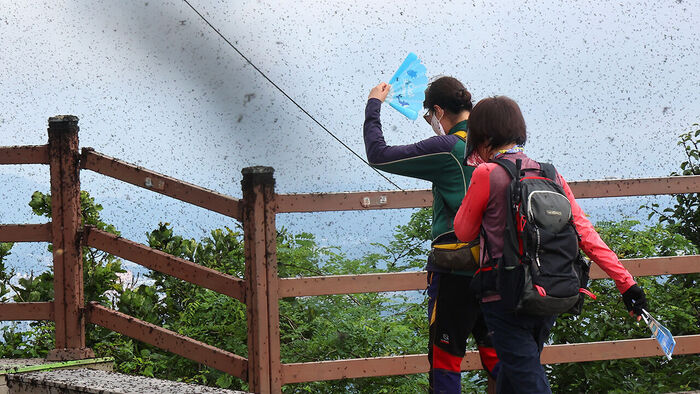
▲ The summit of Gyeyang Mountain covered in lovebugs last year
"The season of lovebugs has arrived. Prepare yourselves," and "I thought we might see fewer of them this year, but they are starting to appear one or two at a time. Is this just the beginning?"
As June marks the emergence of the red-backed hairy fly (*Plecia longiforceps*), commonly known as the "lovebug," online communities in South Korea are flooded with posts expressing concern.
Because they are classified as beneficial insects, chemical pesticides cannot be used against them. Consequently, local governments are deploying eco-friendly pest control measures, while citizens are resorting to creative home remedies as self-defense.
Lovebugs are an invasive insect species known for flying while joined in pairs during mating. They primarily inhabit warm regions such as southeastern China and Okinawa, Japan, but have been observed in South Korea since 2022 due to rising temperatures driven by climate change.
Although they are beneficial insects that do not bite humans and actually help the environment, they have been labeled a major "nuisance insect" causing psychological distress due to their unsightly appearance, overwhelming numbers, and tendency to fly directly at people.
Last year, they appeared in massive numbers across the Seoul metropolitan area, including Gyeyang Mountain in Incheon and Eunpyeong-gu in Seoul, causing widespread disgust and discomfort.
Despite pest control efforts by local governments, including the Seoul and Incheon metropolitan governments, sightings of lovebugs are on the rise again as temperatures climb.
On online communities, users are sharing sightings by region, with posts like "Lovebugs spotted in Songpa-gu," "Found lovebugs in Seocho-gu, probably because of Umyeon Mountain," and "I'm in Incheon, and lovebugs have appeared here."
According to Google Trends, which measures search frequency on a scale of 0 to 100, the search index for "lovebug" reached 100 on June 16.
A "Lovebug Map" website has also emerged to share the locations of lovebug sightings.
The website operates based on user reports of where the insects are spotted.
As of the morning of June 19, about 2,700 reports had been received, with approximately 55% of them confirmed as actual lovebug sightings.
Lovebugs are expected to spread further in the future due to rising temperatures.
In a report titled "Status of Epidemic Urban Pest Proliferation in Seoul and Countermeasures" published in April last year, the Seoul Institute stated, "The lovebugs that have recently appeared in large numbers are presumed to be an invasive species, and they swarm for about two weeks immediately after the monsoon season." The institute added, "There is also domestic research predicting that if temperatures continue to rise at the current rate, lovebugs will spread to all regions of the Korean Peninsula by 2070."
However, because lovebugs are classified as beneficial insects rather than pests, it is difficult to actively control them using chemical pesticides.
On its website, the Seoul Metropolitan Government explains that lovebug larvae enrich the soil by decomposing organic matter underground, while the adults contribute to the ecosystem's cycle by pollinating flowers.
In response, the Seoul Metropolitan Government and district offices are deploying traps and spraying eco-friendly pest control agents instead of chemical pesticides.
Following the deployment of high-altitude traps on Baengnyeonsan and Buramsan mountains, the Seoul Metropolitan Government installed an additional 1,300 attractant traps in parks across 19 districts.
It also conducted pilot sprayings of the eco-friendly microbial pest control agent *Bacillus thuringiensis israelensis* (BTI) over an area of 12,600 square meters around Baengnyeonsan in Eunpyeong-gu and Buramsan in Nowon-gu, where larvae are expected to emerge in large numbers.
A Seoul Metropolitan Government official said, "Pest control is being carried out by each district, with the city overseeing the overall efforts. Although they are classified as beneficial insects, they cause significant inconvenience to citizens, so we plan to continue our control efforts."
As lovebugs continue to appear despite government efforts, residents are taking matters into their own hands.
Various home remedies are being shared on online communities, such as using portable blowers or electric fans to blow them away, and spraying water mixed with vinegar or lemon juice.
However, it has not been officially confirmed whether spraying water mixed with vinegar is actually effective.
Park Sun-jae, a researcher at the National Institute of Biological Resources, said, "We recommend avoiding bright lights and bright clothing, and spraying water to wash them off."
Since official eradication methods like pesticide spraying are difficult to implement in South Korea, methods used overseas, such as in the United States, are also being introduced.
In the U.S., lovebugs have become established, particularly in Florida, where they are classified as a "nuisance pest."
American YouTube channels and other platforms provide guides on how to eliminate them using a mixture of dish soap and water, or by applying pesticides.
Because forced eradication is difficult due to their status as beneficial insects that aid the ecosystem, a "wise coexistence" combining eco-friendly pest control by local governments and smart coping strategies by residents will be necessary for the time being.
(Photo: Yonhap News)
※ Please note: This article was translated by AI and may contain errors.